Intumescent sealant and joint seals
The long thin gaps that never show up as a hole.
- Every seal labelled and photographed
- BM TRADA / FIRAS-certificated contractors
- Written price before any work
Intumescent sealant comes in a cartridge and goes on with a gun, like ordinary decorators' caulk. In a fire it swells and chars into a hard plug. That makes it the most used fire stopping product there is, and the most misused.
Where it belongs
Small annular gaps round a single pipe or cable through a wall or floor, usually up to a size the data sheet sets, with mineral wool packed in behind.
The cut edges of a batt seal and the gaps round each cable that passes through it.
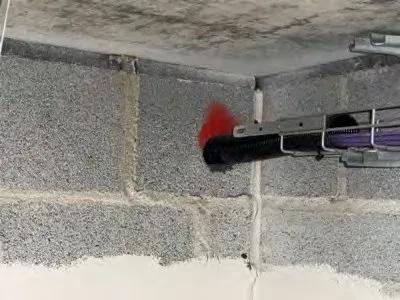
Linear joints. The gap at the head of a wall under a slab, the joint where a new partition meets an old brick wall, the movement joint between two parts of a building.
Where it does not
Big holes. A tube of sealant squeezed into a 100mm gap round a pipe slumps, cracks and falls out. That needs batt, a collar or a mortar fill.
Plastic pipes over the size the sealant was tested on. Those need a collar or a wrap.
Joints that move more than the sealant is rated for.
Depth matters
A data sheet will say the sealant must be, for example, 15mm deep over 50mm of mineral wool, on both faces of the wall. A bead run over the surface of a gap looks sealed and is not. On a survey we often push a probe into a sealant joint and find it is a skin over an empty space.
Old buildings
In Westminster, the joints that cause trouble are where new work meets old. Stud partitions added inside Victorian rooms, built up to a lath ceiling and stopped short. New blockwork against a brick wall that is out of plumb by 30mm over its height. Each gets measured and matched to a tested joint seal.
The work is carried out by our BM TRADA / FIRAS-certificated contractors.
Tell us the street, what the building is used for and send a photo. We will say what it needs and roughly what it costs.